
Addressing the $1.7 trillion gender gap through financial inclusion
03 June 2026
|
1min to read
Access to finance remains one of the main barriers facing women-owned and women-led small and medium-sized enterprises across developing markets. Globally, these businesses face an estimated $1.7 trillion financing gap. That gap limits growth, reduces income opportunities, and holds back broader economic participation. It also reflects a wider imbalance in how financial systems serve women as entrepreneurs, clients, and leaders.
The Global Gender-Smart Fund (GGSF) was created to respond to this challenge through financial inclusion. The fund aims to strengthen the provision of gender-smart and responsible financial services to underserved women, women-owned businesses, and women-led businesses in developing markets.
Structured as a blended finance debt fund, GGSF combines financing with a gender framework designed to support both access to capital and institutional change. Its objective is not only to expand outreach to women and women-led businesses, but also to help financial institutions improve how they serve women and how they embed gender considerations in their own operations.
Building on a long track record in financial inclusion

GGSF builds on the history of the Microfinance Enhancement Facility, or MEF, which was launched in 2009 as an emergency response to the global financial crisis. Over time, MEF became an established financial inclusion vehicle, providing liquidity to financial institutions serving low-income households, microentrepreneurs, and small businesses across developing markets.
Effective 1 January 2024, MEF was restructured into the Global Gender-Smart Fund with a refined strategy focused on gender-smart investing and responsible finance. The shift reflected a clear market need: financial inclusion efforts must address not only access to funding, but also the specific barriers women face within financial systems and markets.
That evolution gives GGSF an unusual combination of continuity and focus. It builds on a 15-year track record in financial inclusion while applying a more targeted gender strategy to current market needs.
What gender-smart investing means in practice
Gender-smart investing, sometimes referred to as gender-lens investing, uses capital to pursue financial returns while advancing gender equality. For GGSF, that means integrating gender analysis into investment decisions and looking at both client outreach and institutional practices.
In practice, the fund supports partner financial institutions that already show gender-smart practices or demonstrate a clear commitment to strengthening them. This can include improving gender balance at board, management, and staff level, strengthening internal policies, and developing products and services that respond better to the needs of underserved women and women-led businesses.
This dual focus is central to the strategy. GGSF is designed to expand financial inclusion for women while also supporting progress within the institutions it finances.
A strategy designed for outreach and institutional change
GGSF provides private debt financing to partner financial institutions across developing markets globally. The fund invests through debt instruments, including senior and subordinated loans, and works through these institutions rather than lending directly to end-clients. The partner financial institutions then on-lend to eligible target clients.
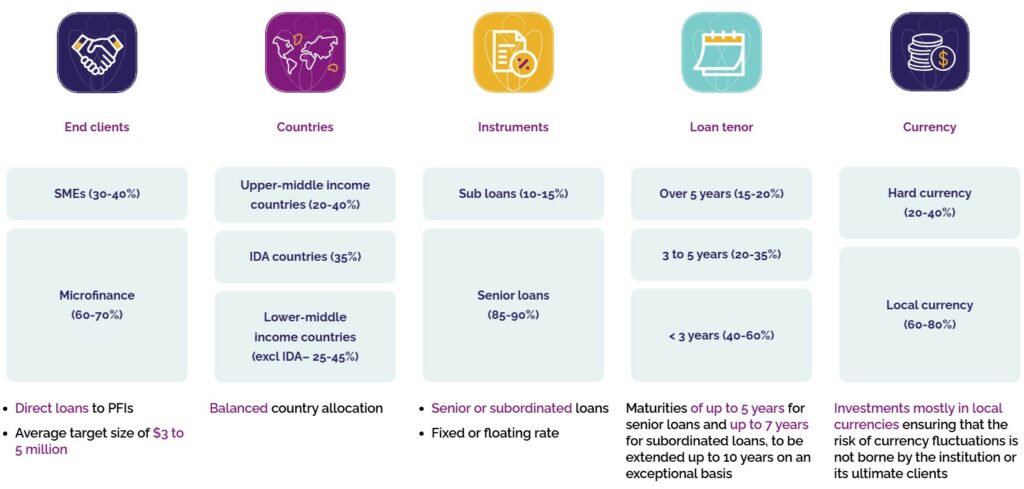 Each potential investment is assessed not only from a financial perspective, but also through a detailed gender assessment. Partner financial institutions are expected to demonstrate management commitment and put in place a Gender Action Plan with clear targets. These action plans are monitored on a quarterly basis.
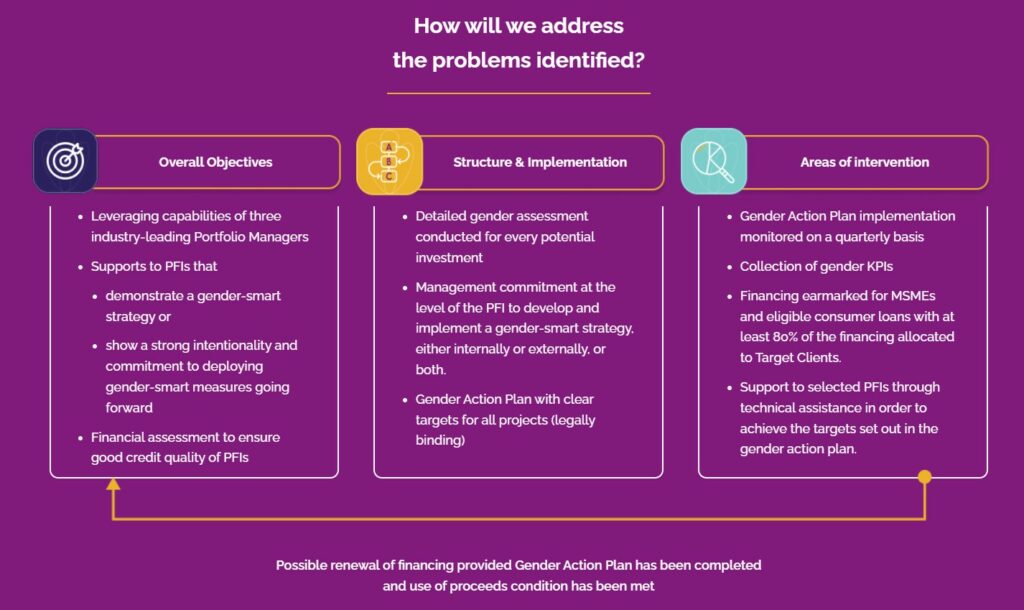 The financing is earmarked for eligible end-clients, with at least 80% allocated to target clients. Those target clients include underserved women, women-owned businesses, and women-led businesses. This structure helps the fund support outreach while encouraging stronger systems, better data collection, and a more intentional gender strategy within financial institutions.
Public sustainability disclosures also show that the fund monitors progress through pre-defined key performance indicators and principal adverse impact indicators, which are collected and reported to stakeholders annually.
The role of technical assistance
A core part of the GGSF model is its Technical Assistance Facility, supported by Niras and Women’s World Banking. The facility is designed to help partner financial institutions make gender equity a more integrated part of their operations, improve their own gender performance and strategies, and develop gender-smart products and services for final beneficiaries.
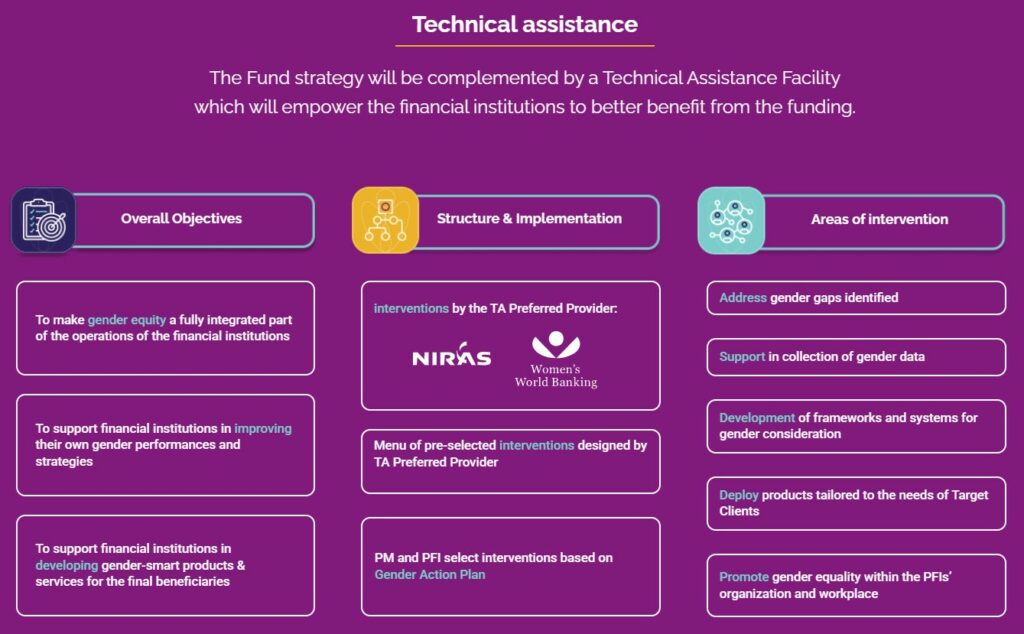
This means capital is combined with practical support. Technical assistance can help address gaps identified during due diligence, strengthen internal frameworks, improve gender data collection, and support the design of products that better respond to the needs of women clients and women-led businesses. It can also support progress on workplace practices and governance.
Innpact’s contribution
Innpact has played a key role in the fund’s development over time. It was already involved with MEF from launch, having supported the design, set-up, and launch of the fund in 2009. Since then, Innpact supported MEF as general secretary and strategic advisor, providing fund management support, coordination services, compliance support, and investor relationship management.
Building on that long-standing involvement, Innpact also supported the restructuring of MEF into the Global Gender-Smart Fund, including work on the investment strategy, impact management system, and governance framework. Since 1 January 2024, Innpact Fund Management S.A. has served as the fund’s Alternative Investment Fund Manager. In that role, it is responsible for global portfolio management, placement, impact management, and the management of the Technical Assistance Facility.
Portfolio management is delegated to three specialized managers with strong experience in financial inclusion and gender finance: Incofin Investment Management, responsAbility Investments, and Triple Jump. Together, this structure combines strategic oversight, investment experience, and impact discipline within one framework.
A structure focused on developing markets
GGSF is a Luxembourg S.A., SICAV-SIF and qualifies as an Article 9 fund under the Sustainable Finance Disclosure Regulation. The fund is active in developing markets across the globe, with a focus on IDA and IDA-eligible countries, and invests through private debt instruments provided to partner financial institutions.
Its strategy is designed to help those institutions become more gender-smart over time by strengthening products, internal policies, governance, and outreach. GGSF is therefore more than a financing vehicle. It is also a platform for helping financial institutions embed gender more fully into the way they operate.
As of 31 December 2025, the fund had total assets of USD 670 million and had financed 110 partner financial institutions across 37 countries.
Looking ahead
Addressing the gender gap in finance requires more than capital alone. It requires financial institutions that are equipped to serve women more effectively, stronger internal systems, and investment strategies that treat gender as a core part of financial inclusion.
The Global Gender-Smart Fund was designed with that in mind. By combining private debt financing, gender assessment, action plans, and technical assistance, GGSF supports a more intentional approach to gender-smart finance in developing markets. It builds on an established track record while focusing on a clear objective: helping close the gender finance gap through responsible financial services and stronger institutions.
For Innpact, GGSF reflects a broader commitment to structuring and managing impact finance vehicles that respond to market needs while contributing to measurable social outcomes.